
Standing MRI for horses
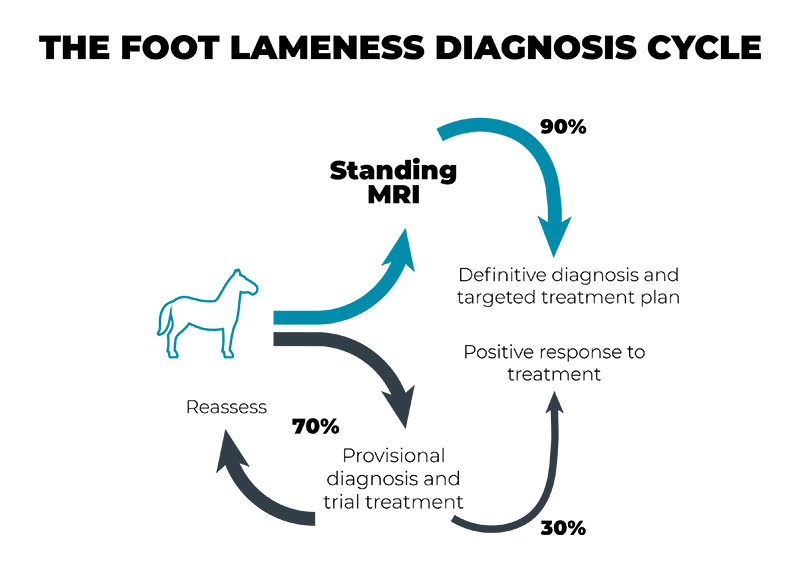
Standing MRI is the only diagnostic imaging technology to show both bone and soft tissue in a horse's distal limb. This service is referral-only.
At UQ VETS Equine Specialist Hospital, our highly trained imaging staff use on-site Magnetic Resonance Imaging (MRI) to examine your horse while it's standing.
Watch our video
See how we prepare a horse for standing MRI and carry out the exam. (YouTube 2m: 39s)
When do we use standing MRI?
We'll use standing MRI to:
- diagnose bony and soft-tissue disease (when other diagnostic imaging is negative, unclear or difficult to access)
- diagnose performance-limiting pathology in racing thoroughbreds
- assess penetrating injuries or fractures (if your horse needs more investigation after radiography)
- help with surgical planning (when your horse doesn't need surgery with anaesthesia)
- monitor your horse's rehabilitation progress, treatment and to speed up its return to competition
- diagnose navicular disease and deliver targeted treatment
- identify if your horse is at risk of fetlock fractures (this can lead to palmar osteochondral disease caused by repetitive fast work)
- identify early on if your horse has subtle lesions such as bone inflammation and early onset degenerative joint disease
- complement your horse's lameness evaluation.
Can I stay with my horse during the exam?
You'll need to leave your horse with our highly trained staff to conduct the exam. You won't be able to watch the MRI exam because the equipment is sensitive to room temperature.
MRI booking includes a minimum of two nights stay. Your horse will arrive the day before the MRI, have their scan the following day, and go home after staying the night with us. This is all included in the price of the MRI.
A team member will notify you when you're able to collect your horse.
How long does it take?
Standing MRI is a time-consuming process. It is different to Computed Tomography (CT) which can provide us with images in minutes.
The timing of the MRI is quite variable and can be difficult for us to predict in advance. Depending on the horse and the area being examined, the process can take anywhere from half a day to a full day.
With standing MRI, we'll need time to:
- prepare your horse (we'll remove all magnetic items including your horse's shoes before the exam and your horse will be sedated)
- carry out the exam
- quality-control the images
- review the images.
If we're assessing your horse's lameness, we'll need to localise a specific part of your horse's anatomy so we can focus on the correct location.
MRI booking includes a minimum of two nights stay. Your horse will arrive the day before the MRI, have their scan the following day, and go home after staying the night with us. This is all included in the price of the MRI.
If your horse needs a comprehensive exam (across multiple regions) or we're examining complicated anatomy, it may take longer.
On rare occasions, your horse's standing MRI exam may be delayed by an emergency case.
Why does my horse need to stay the night before?
We find horses generally settle much better when they have had some time to get used to the hospital environment before their MRI. A relaxed horse is easier to sedate and helps us to obtain the best possible image quality.
Having them arrive the day before also give our team an opportunity to get to know your horse and ensure that everything is appropriately prepared for the scan. For example, we will need to remove shoes prior to the MRI scan.
We also aim to start MRI examinations first thing in the morning wherever possible. Having horses admitted the day before allows us to do that efficiently, without asking owners to travel early into the morning or risking unforeseen delays.
Overall, arriving the day before helps make the experience smoother for both your horse and our teams, and give us the best opportunity to obtain high-quality images.
Why does my horse need to stay the night after an MRI?
There are two main reasons. Firstly, we monitor your horse as the sedation wears off to make sure they are comfortable and doing well.
Secondly, MRI studies require a thorough review after the scan has been completed. Occasionally, once our clinicians and imaging specialist have reviewed the images, they may identify that additional or repeat imaging is required before discharge. We want to ensure that we have the time needed to acquire all the imaged necessary for the final diagnosis.
Why does my horse need their shoes removed for the procedure?
MRI utilises a magnet to obtain images and therefore any metal objects in or near the field of view can affect the image quality. For this reason, any shoes on the limb of interest and the accompanying front or hind limb must be removed. This will be done on site by our staff and the shoes kept and returned to you at the time of discharge. If you would prefer your own farrier remove the shoes, please ask that they take care when removing nails so as to not leave any residual metal in the hoof wall.
- Can your horse hear you?
- Equine metabolic syndrome (EMS) and laminitis
- Identifying and reducing the risk of cellulitis in horses
- Prepare and monitor your expectant mare
- Standing MRI for horses
- UQ case study for treating forelimb lameness
- Understanding equine anaesthesia
- What causes laminitis in horses and how is it treated?
- What is Pituitary pars intermedia dysfunction (PPID)?
- What to do if your horse has a sore eye
